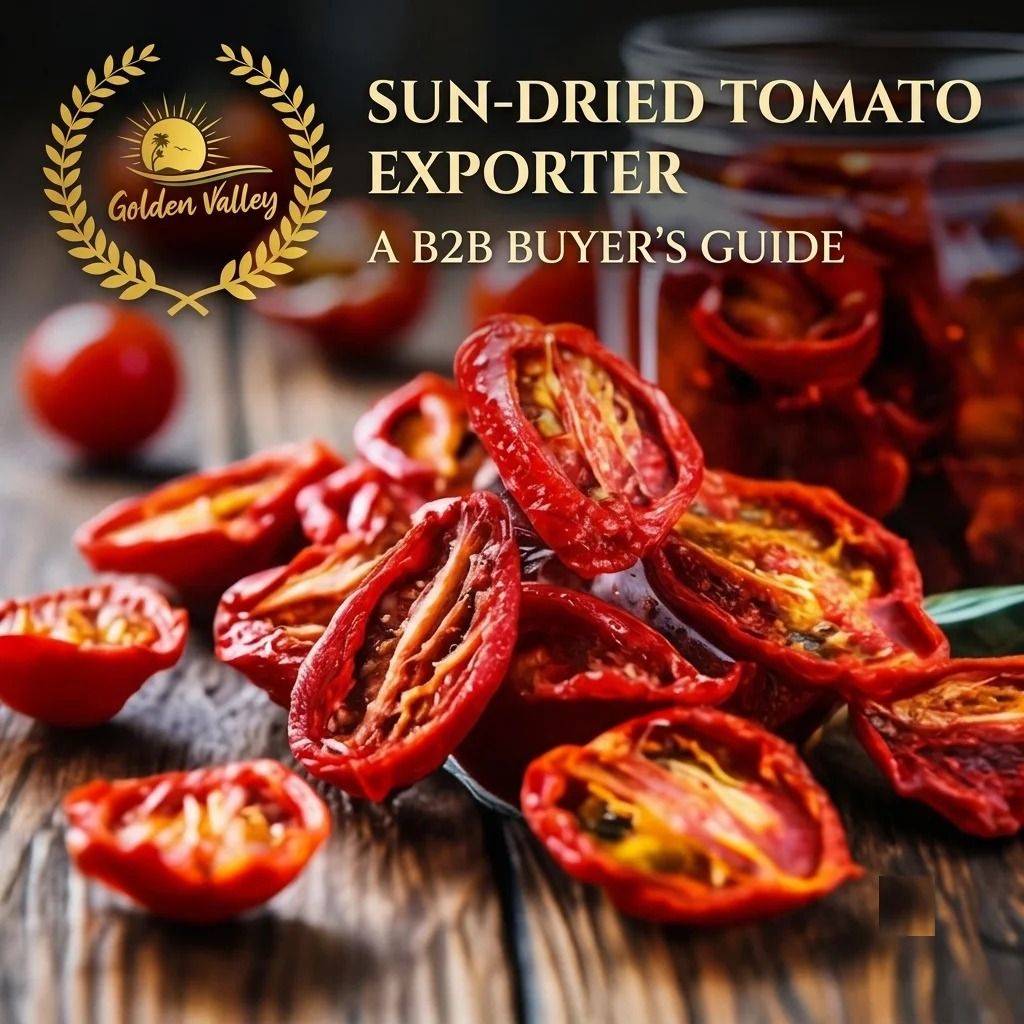
Sun-Dried Tomato Exporter: A B2B Buyer's Guide Choosing the right sun-dried tomato exporter can directly affect your product quality, production consistency, costs, and supply-chain reliability. For international buyers, food manufacturers, distributors, and wholesale customers, Golden Valley offers an export-focused sourcing solution for premium sun-dried tomatoes from Egypt, combining controlled processing, consistent quality, and international logistics support. Egypt's strong agricultural base provides access to quality tomatoes and supports competitive sourcing for international markets.
Sun-Dried Tomato Exporter: A B2B Buyer's Guide
For international buyers, choosing the right sun-dried tomato exporter means evaluating much more than price; product specifications, moisture content, processing methods, packaging, food-safety controls, documentation, and export reliability all influence the total value of a sourcing decision. Golden Valley, an Egyptian B2B agricultural exporter, supplies sun-dried tomatoes produced in Upper Egypt from ripe tomatoes harvested at peak season. Its product range includes whole halves, flakes, coarse granules, and finely milled powder, with private-label and OEM options available for food processors, spice blenders, and seasoning manufacturers.
For procurement managers and importers, Egypt offers an attractive sourcing location because of its agricultural resources, strong sunlight, and established access to international markets. Golden Valley combines these advantages with controlled processing, flexible packaging, product documentation, and export-orientated supply capabilities. Its broader product portfolio also includes dried vegetables such as eggplants, zucchini, potatoes, and sweet potatoes, allowing buyers to consolidate sourcing requirements where appropriate.
Discuss customised products, packaging, and private-label solutions for your market.
How Do You Choose the Right Sun-Dried Tomato Exporter?
The right sun-dried tomato exporter should be able to demonstrate consistent product quality, reliable supply, transparent specifications, appropriate food-safety controls, flexible packaging, and professional export support. Buyers should assess the supplier as a long-term supply-chain partner rather than comparing quotations on price alone. For a B2B buyer, the initial evaluation should cover:
- Country and region of origin.
- Tomato variety and raw-material quality.
- Product format and cut size.
- Moisture specification.
- Additives, preservatives, salt, and sulphites.
- Production and drying method.
- Packaging options and pack sizes.
- Shelf life and storage requirements.
- Certificates and technical documentation.
- Minimum order quantity and production capacity.
- Lead time and shipment planning.
- Private-label, OEM, or custom-processing capabilities.
- Export documentation and destination-market compliance.
Golden Valley provides a particularly relevant sourcing model for buyers looking for Egyptian sun-dried tomatoes; its published specifications identify Egypt as the country of origin and state that the tomatoes are produced in Upper Egypt, naturally dried under the sun, and processed into multiple granulations according to customer requirements.
A strong exporter should also provide samples before commercial approval; this allows procurement teams to compare appearance, flavour, texture, moisture, granulation, and overall suitability for their manufacturing process before committing to a larger shipment.
Get competitive pricing for premium sun-dried tomatoes from Egypt.
What Should B2B Buyers Look for in a Sun-Dried Tomato Exporter?
B2B buyers should prioritise consistency, traceability, customisation, documentation, and supply reliability because these factors directly affect production efficiency and customer satisfaction; a low purchase price has limited value if inconsistent moisture or texture creates processing problems or increases production waste.
Golden Valley's published B2B offering includes several features that can simplify commercial sourcing; the company offers sun-dried tomato halves, irregular flakes, coarse granules, and finely milled powder. It also provides customised packaging and private-label and OEM options for food processors, spice blenders, and seasoning manufacturers.
For manufacturers, the ability to specify the product format is particularly important; a sauce producer may prefer tomato powder, while a pizza or ready-meal manufacturer may require halves or flakes. Seasoning companies may need a specific granulation to achieve consistent blending and dispersion. Buyers should also ask whether the supplier can provide:
- Product data sheets.
- Certificates of Analysis (COA).
- Samples for pre-shipment or pre-purchase testing.
- Batch and traceability information.
- Packaging specifications.
- Shelf-life information.
- Export documentation.
- Destination-specific compliance documents.
Golden Valley states that product data sheets, COAs, and samples are available upon request, giving buyers the documentation needed for technical evaluation and supplier qualification.
Evaluate Golden Valley’s sun-dried tomato quality before placing your bulk order.
What Quality Standards Should Sun-Dried Tomatoes Meet for Export?
Export-quality sun-dried tomatoes should meet clearly defined specifications for food safety, moisture, appearance, flavour, packaging integrity, and microbiological quality, with the exact requirements determined by the destination country and buyer's application. HACCP, or Hazard Analysis and Critical Control Points, is a preventive food-safety system used to identify and control potential hazards during food production.
Golden Valley states that its sun-dried tomato products are packed under HACCP guidelines and that its broader quality system is based on ISO 22000 and HACCP requirements. ISO 22000 is an international food-safety management standard designed for organisations throughout the food chain. Golden Valley's published product specification lists:
- Ingredients: 100% tomato.
- Country of origin: Egypt.
- Colour: Deep red.
- Taste: Characteristic sweet and tangy tomato flavour.
- Moisture: Below 8%.
- Bulk density: 0.35 ± 0.05 g/ml.
- Shelf life: 18 months under cool, dry storage conditions.
The company also states that its sun-dried tomatoes contain no added salt or sulphur dioxide and are produced without additives or preservatives.
It is important for buyers to distinguish between standards that are actually applicable to food ingredients and unrelated industrial standards. For example, CE marking primarily concerns certain products placed on the European market, while ASTM and EN standards apply to specific products, materials, or testing requirements. They should not automatically be treated as universal requirements for dried tomato ingredients. Instead, buyers should identify the food-safety, labelling, phytosanitary, residue, microbiological, and import requirements applicable to their destination market.
Contact Golden Valley to discuss distribution, bulk supply, and long-term export opportunities.
How Can Buyers Verify the Quality of Sun-Dried Tomatoes Before Ordering?
The most reliable approach is to approve a representative sample against an agreed technical specification before placing a bulk order. Buyers should evaluate both sensory characteristics and laboratory parameters rather than relying solely on photographs or supplier descriptions. A practical pre-order verification process can include:
- Sample evaluation: Check colour, aroma, flavour, texture, cut size, and visible impurities.
- Moisture testing: Confirm that the product meets the agreed moisture specification.
- Microbiological testing: Evaluate relevant food-safety parameters according to the destination market and intended application.
- Chemical analysis: Test parameters such as pesticide residues, heavy metals, or other requirements where applicable.
- COA review: Compare the supplier's Certificate of Analysis with the approved product specification.
- Packaging inspection: Verify food-grade materials, sealing, labelling, and package weight.
- Traceability review: Confirm the ability to identify the production batch and relevant raw-material information.
Golden Valley specifically invites B2B customers to request samples, product data sheets, and Certificates of Analysis before proceeding; its published product information also provides measurable specifications such as moisture, bulk density, shelf life, colour, and ingredient composition, giving buyers a useful technical basis for supplier qualification.
For larger contracts, procurement managers can establish an approved specification sheet covering every critical parameter; this reduces ambiguity and creates a clear quality benchmark for future shipments.
Explore Golden Valley’s sun-dried tomato formats and B2B export solutions.
What Types of Sun-Dried Tomatoes Are Available for B2B Buyers?
B2B buyers can choose between several sun-dried tomato formats depending on their manufacturing process, application, and packaging strategy. Golden Valley offers whole halves, irregular flakes, coarse granules, and finely milled tomato powder, allowing the same raw material to serve different industrial applications. The main formats can be matched to applications as follows:
- Sun-dried tomato halves: Suitable for foodservice, gourmet products, ready meals, pizzas, salads, and applications where visible tomato pieces are desired.
- Tomato flakes: Useful for seasoning blends, sauces, soups, prepared foods, and ingredient mixes.
- Coarse granules: Appropriate for industrial food formulations where controlled particle size is important.
- Tomato powder: Suitable for sauces, soups, seasonings, spice blends, bakery formulations, and other products requiring concentrated tomato flavour in an easily blended form.
Sun-Dried Tomato Exporter: A B2B Buyer's Guide For companies sourcing from Egypt, working with an experienced exporter can simplify procurement while creating opportunities for competitive pricing, customised specifications, and dependable international supply. Golden Valley's export-orientated approach makes it a strong option for buyers seeking a long-term sun-dried tomato supplier in Egypt.
What should I consider when choosing a sun-dried tomato exporter in Egypt?
Quality, consistency, documentation, production capability, and export experience should come before price. International buyers should evaluate the tomato origin, drying process, moisture specification, available formats, packaging, quality assurance procedures, certifications, and ability to meet destination-country requirements. Golden Valley supplies sun-dried tomatoes from Egypt in formats including halves, flakes, coarse granules, and finely milled powder.
What factors affect the price of bulk sun-dried tomatoes?
Product format, order volume, packaging, specifications, customisation, and shipping destination are major pricing factors. The price of bulk sun-dried tomatoes can vary according to whether the buyer requires halves, flakes, granules, or tomato powder, as well as the required moisture level, packaging format, private-label requirements, and total order quantity.
What MOQ, packaging, and customisation options are available for B2B buyers?
MOQ and packaging should be confirmed according to the product format, order specifications, and customisation requirements. Golden Valley offers B2B packaging solutions, including bulk formats and customised packaging, with options such as 25 kg bags and smaller packs where applicable.
What quality assurance and testing should buyers request before placing an order?
Buyers should approve a representative sample and verify the agreed technical specification before committing to a commercial shipment. Key checks can include moisture content, appearance, colour, flavour, texture, particle size, microbiological parameters, pesticide residues, and other destination-specific requirements.
How does Golden Valley handle international shipping and export documentation?
International shipments should be planned around the buyer's destination requirements, agreed Incoterms, packaging specifications, and required export documents. Depending on the destination and commercial agreement, buyers may need documents such as a commercial invoice, packing list, Certificate of Origin, Certificate of Analysis, phytosanitary documentation, and other customs-compliance documents.
Contact us: You can contact Golden Valley to enquire about any information through the following methods:
- Call us at: +20-227036135 - WhatsApp +20-01002844111
- Send an email to: othmanelshaikh@goldenvalley-eg.com.
- Visit us at 75 Saudi Building, Oroba St, Maadi, Cairo, Egypt.
- LinkedIn – YouTube.
- Submit your inquiry on our website here.